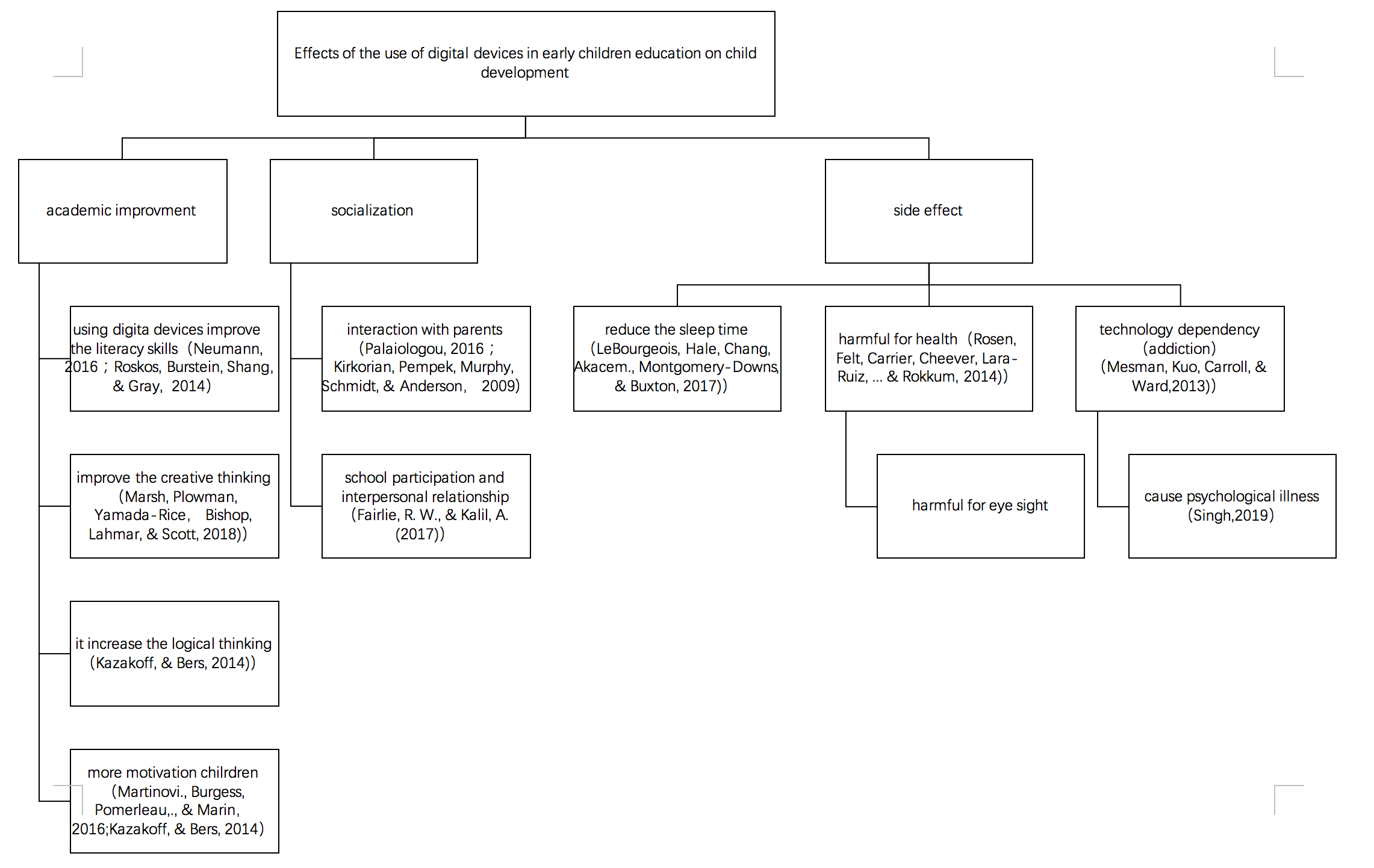
Literature map
My topic is the advantages and disadvantages of using digital device for yongchildren.In the last few decades, technology has changed almost every aspect of our society, from the way we work to the way we socialize and everything in between. One of the most striking differences is the way children play and interact compared with previous generations.A large number of children are exposed to digital technologies such as touch screens at home long before entering pre-school (Cohen, Hadley, & Frank, 2011; Ebbeck, Yim, Chan, & Goh, 2016).According to a study,The average age of a child starting to use a touch-screen device was about 11 months.This means that the child knows how to use electronic devices before he learns to speak and develop a complete thinking system. On the one hand, children’s behaviors are influenced by their parents. On the other hand, many parents are willing to guide their children to use electronic devices for entertainment and study.And based on my personal experience, many parents believe the smart APP, or some educational technology would be a supplementary resource for improving young children’s’ learning ability.
As a result, I would like to discuss how the digital technology influence young children’s’ learning and it’s advantages and drawbacks.
Reference
Cohen, M., Hadley, M., & Frank, M. (2011). Young children, apps & iPad. New York, NY: Michael Cohen Group.
Neumann, M. M. (2016). Young children’s use of touch screen tablets for writing and reading at home: Relationships with emergent literacy. Computers & Education, 97, 61-68.
Roskos, K., Burstein, K., Shang, Y., & Gray, E. (2014). Young children’s engagement with e-books at school: Does device matter?. Sage Open, 4(1), 2158244013517244.
Marsh, J., Plowman, L., Yamada‐Rice, D., Bishop, J., Lahmar, J., & Scott, F. (2018). Play and creativity in young children’s use of apps. British Journal of Educational Technology, 49(5), 870-882.
Kazakoff, E. R., & Bers, M. U. (2014). Put your robot in, put your robot out: Sequencing through programming robots in early childhood. Journal of Educational Computing Research, 50(4), 553-573.
Martinovic, D., Burgess, G. H., Pomerleau, C. M., & Marin, C. (2016). Computer games that exercise cognitive skills: What makes them engaging for children?. Computers in Human Behavior, 60, 451-462.
Palaiologou, I. (2016). Children under five and digital technologies: implications for early years pedagogy. European Early Childhood Education Research Journal, 24(1), 5-24.
Kirkorian, H. L., Pempek, T. A., Murphy, L. A., Schmidt, M. E., & Anderson, D. R. (2009).The impact of background television on parent–child interaction. Child development, 80(5), 1350-1359.
Fairlie, R. W., & Kalil, A. (2017). The effects of computers on children’s social development and school participation: Evidence from a randomized control experiment. Economics of Education Review, 57, 10-19.
LeBourgeois, M. K., Hale, L., Chang, A. M., Akacem, L. D., Montgomery-Downs, H. E., & Buxton, O. M. (2017). Digital media and sleep in childhood and adolescence. Pediatrics, 140(Suppl 2), S92.
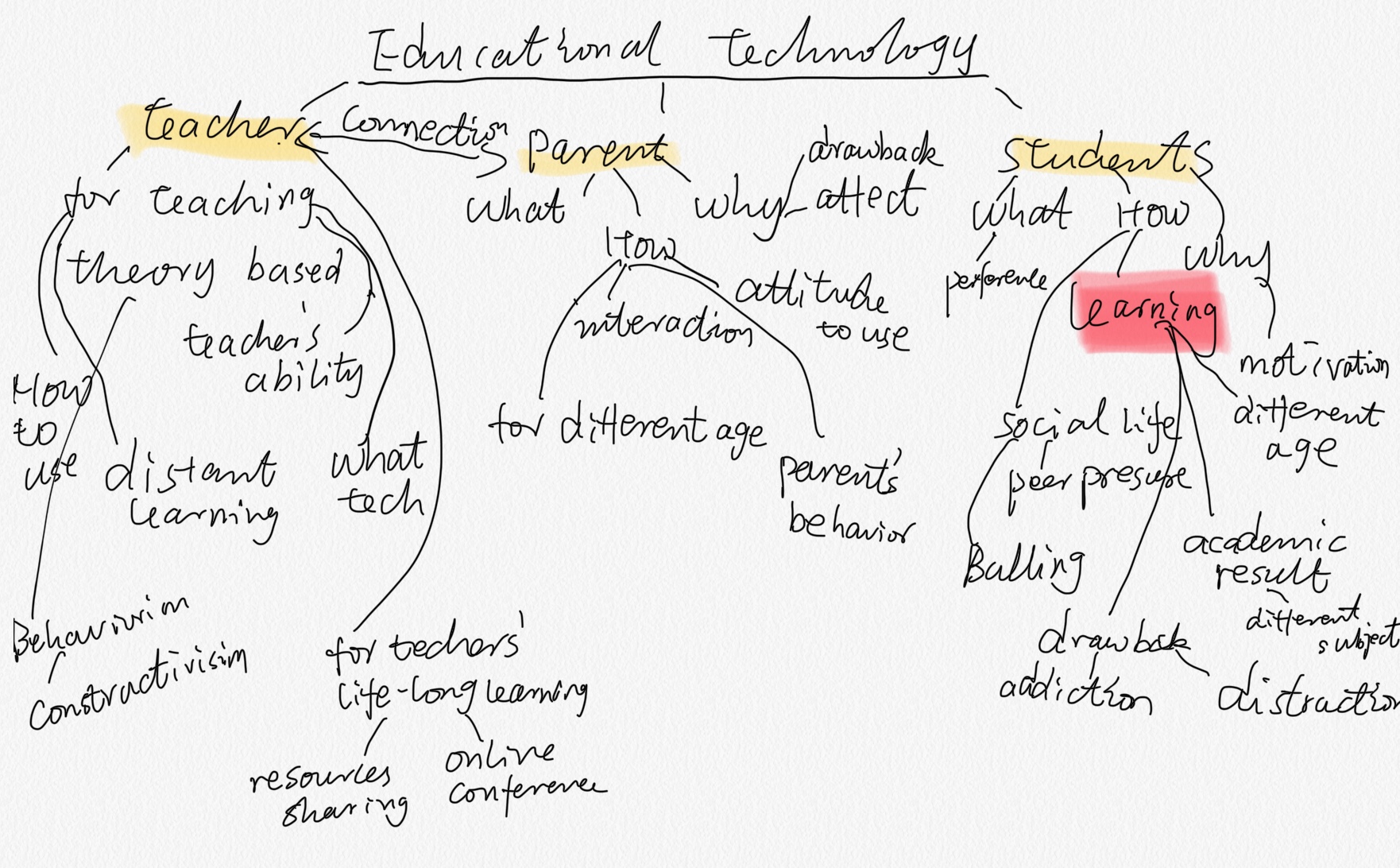
In the educational technology area, I start my thinking from three part: teacher, parents and students. In each part, I asked what, why and how questions to narrow down my thinking. To be more specific, in the teacher part, my main focus is on how teacher teach with technology. For the parents part, how parents’attitude and behavior influence the use of technology is highly concerned. For the students part, I pay more attention on how they learn and the outcome of learning with technology. Here is the map of my brainstorm.
I am interested in the reading “Learning by any other name: Communication research traditions in learning and media.“in week 3. It discuss the communication from three area:technology,phycology ,social cultural background. The key point in phycology part address that everyone handles the same information from media differently,and the parental habit or value would influence children’s attitude and opinion when they get attached with information though TV, internet,social media… This point of view inspire me a lot when I try to figure out how social media changes children’s value.
There is an example from my internship experience as a teacher in China. I find that children whose parents repost context about games in social media are more likely to prefer playing games when they learn. It shows parents’ attitude would influence children’s attitude toward games. However, it occurs to me that my teacher in primary school suggested parents reduce the time watching some amusement shows which are not suitable for children when children come back home. Children will imitate their parents’ behavior and follow their attitude towards entertainment programs.If parents cut back on watching such programs, and parents think the programs are not interesting , can greatly reduce children’s addiction to such programs.
The reading and the personal experience reminds me that the connection with parents is really important for children’s education.If I want to solve the problem of children’s online game addiction, as a teacher, I can start from the parents.We can encourage parents to watch more educational interesting news and TV programs with their children, and parents can also actively share their views with their children.

